Tensor basics
Create tensors, try broadcasting, and trace a gradient.
tensor_basics.py
THE EXPERIMENT LAB / LEARN BY CHANGING THINGS
Real scripts. Locally generated data. A starting point for your next experiment with neural computing.
Showing all 12 experiments. Run commands from the EveryO framework repository root.
Create tensors, try broadcasting, and trace a gradient.
tensor_basics.py
Fit a single Linear layer with SGD and momentum.
linear_regression.py
Train a dense network and plot its learning curves.
neural_network.py
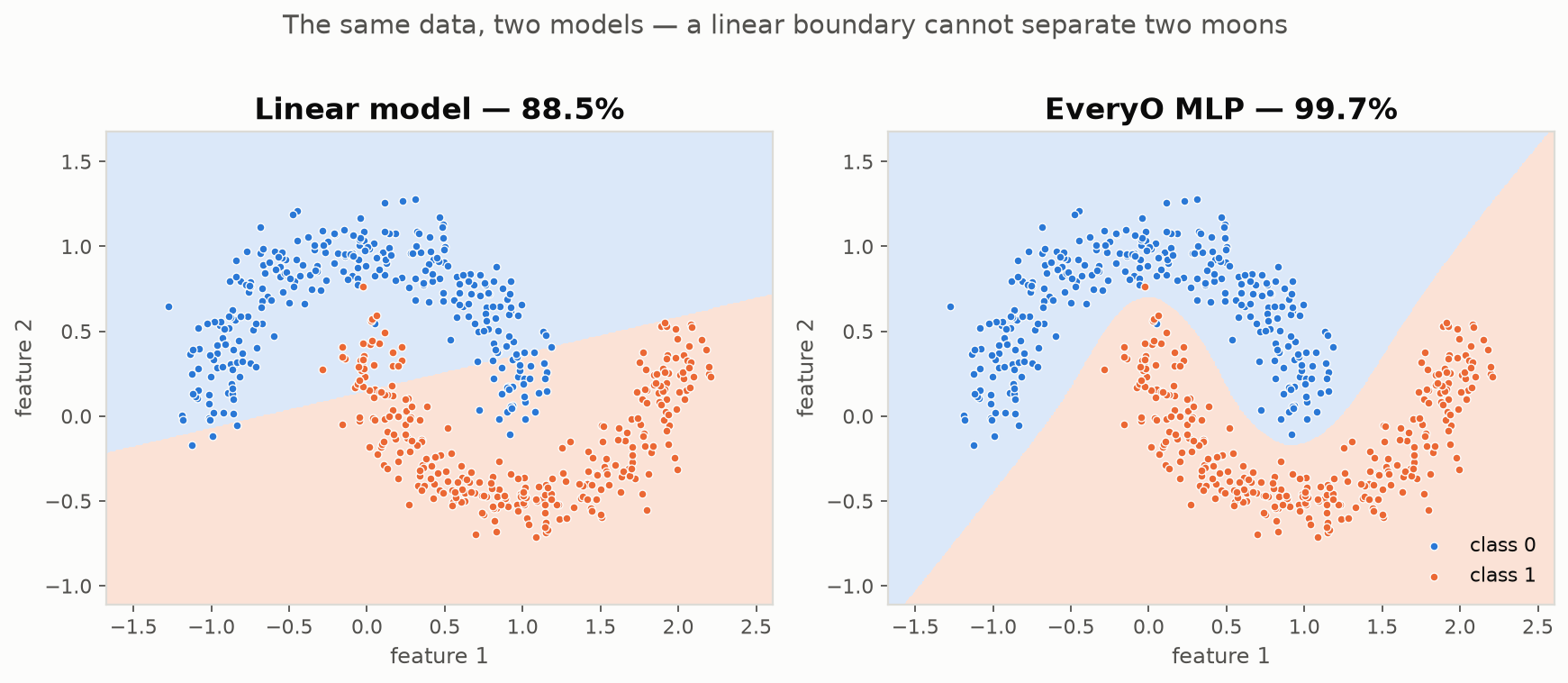
Compare a linear model and MLP on two moons.
binary_classification.py
Compare a CNN to a dense baseline and inspect learned filters.
convolutional_network.py
Explore RNN, LSTM, GRU, and transformer long-range recall.
sequence_models.py
Save, inspect, and reload a pickle-free .evo archive.
save_and_load.py
Export a supported CNN and check it with ONNX Runtime.
onnx_export.py
Profile model timing and export a performance trace.
profiling.py
Compare CPU data parallelism with a single-process run.
distributed_training.py
Explore autocast, GradScaler, and floating-point underflow.
mixed_precision.py
Compare dynamic INT8 quantization with the float model.
quantization.py
MAKE THE ABSTRACT VISIBLE
See how an MLP handles a curved classification problem. Change the hidden layers, learning rate, or seed, then compare the results.
Figures show measurements from documented example runs, not guaranteed outcomes.